
There is a lot of noise around AI at the moment.
For some businesses, there is excitement. For others, there is hesitation, confusion or even panic. It can feel as though AI has suddenly appeared and changed everything overnight.
But AI itself is not new. We have been using it for years, often without really thinking about it. From spellcheck and predictive text to search engines and automated recommendations, AI has been part of everyday life for a long time.
What has changed is the scale, speed and accessibility of the tools now available.
Businesses of all sizes are now using AI to support content creation, research, reporting, planning, client service and internal processes. Used well, it can save time, improve efficiency and support better decision making.
Used without direction, it can just as easily lead to generic content, confused messaging and wasted effort.
The difference comes down to strategy.
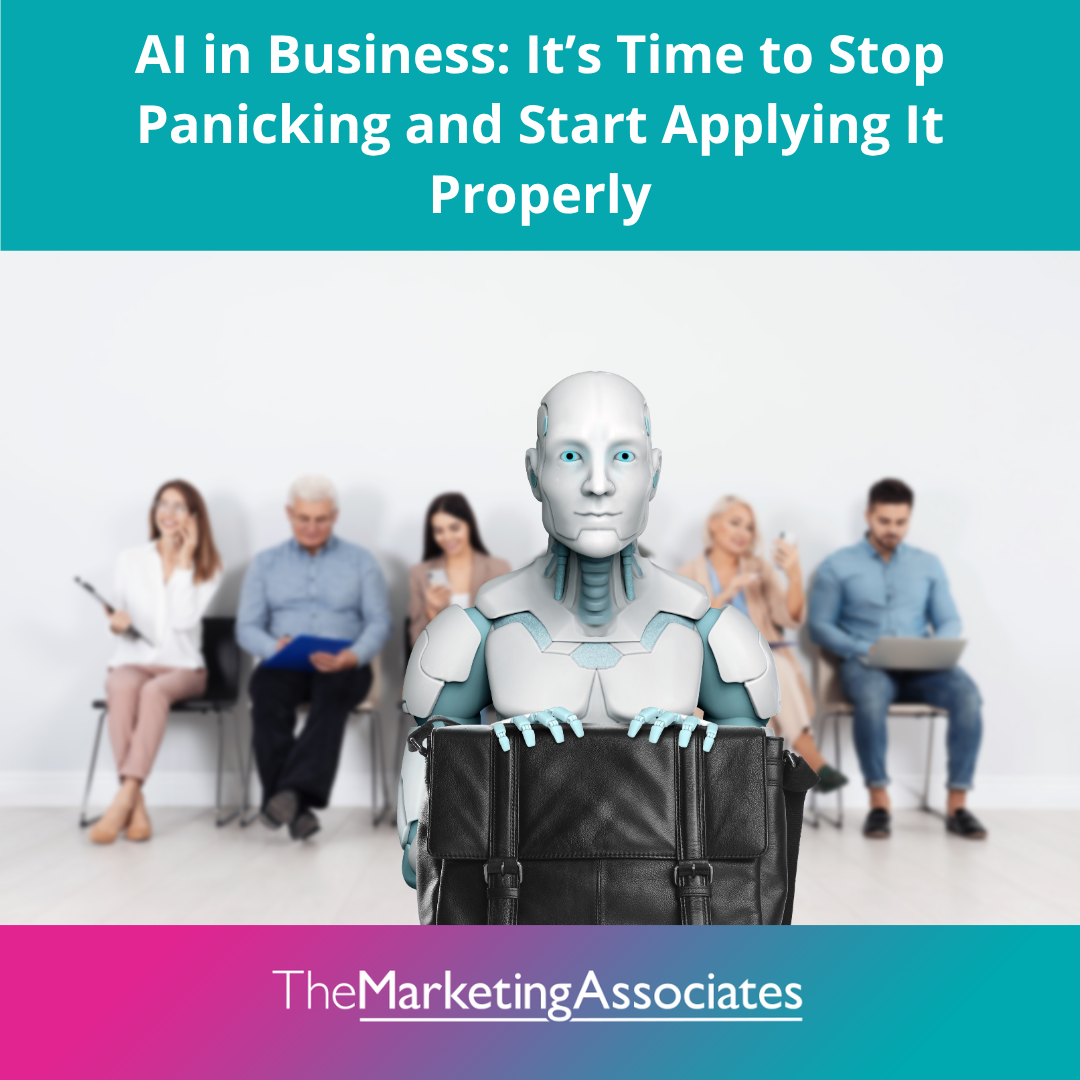
AI is not your strategy
One of the biggest mistakes businesses make is starting with the tool rather than the outcome.
A new platform appears, people start testing it, and before long there is a lot of activity without a clear purpose. But AI is not a strategy. It is a tool that can help support a strategy.
Before choosing platforms, prompts or automation, it is worth asking what you are actually trying to achieve.
Are you trying to save time, improve your marketing, generate better leads, strengthen your client experience or make internal processes more efficient?
Once the objective is clear, AI becomes much easier to apply in a useful way.
Without that clarity, it can quickly become another distraction. You may produce more content or move faster, but that does not always mean the work is more effective.
Use AI carefully
AI can be extremely helpful, but it is not always right.
Large Language Models do not “know” things in the way people often assume. They generate responses based on patterns, probability and the information available to them.
In simple terms, they can often tell you what sounds right, but that does not always mean it is right.
This is where businesses need to be aware of bias, hallucinations and cross validation.
AI hallucinations happen when a tool produces information that sounds convincing but is inaccurate. It might create a statistic, reference, example or fact that appears credible, but does not actually exist.
The challenge is that AI rarely sounds unsure. It can present an incorrect answer with confidence, which makes it easy to trust if you are not checking the output properly.
For anything important, AI should be treated as a starting point, not the final answer.
Cross check before you rely on it
If you are using AI for research, marketing strategy, client work or business decisions, cross checking should be part of the process.
A simple approach can help:
- Ask the same question across more than one AI platform
• Compare the answers
• Check key facts against trusted sources
• Question anything that sounds too neat or too confident
• Use your own judgement before making decisions
This does not mean AI should be avoided. Far from it.
It means it should be used properly.
The businesses that benefit most from AI will not be the ones using it the most. They will be the ones using it thoughtfully, with the right checks in place.
Good inputs lead to better outputs
The phrase “rubbish in, rubbish out” has never been more relevant.
AI is only as useful as the information and direction you give it. If your prompts are vague, your outputs are likely to be vague too.
This is especially true in marketing.
Before using AI to support your marketing, you need to be clear on who you are trying to reach, what you want to say, what makes your business different and what action you want people to take.
Without that foundation, AI may help you create content faster, but it will not necessarily make that content more effective.
It may sound polished, but still feel generic.
That is why strategy comes first. AI can help with delivery, but it cannot replace clear thinking.
People still buy people
However advanced AI becomes, the human element remains essential.
This is particularly true in high trust sectors such as legal, financial, manufacturing and professional services.
Clients want expertise, but they also want confidence, empathy and understanding. They want to know that the people advising them understand their business, their challenges and their goals.
AI can support communication, content, research and internal efficiency. But it cannot replace trust.
People still buy people. AI should support that relationship, not get in the way of it.
Let’s talk strategy
AI is not a replacement for expertise. It is not a shortcut for strategy. And it will not solve unclear marketing on its own.
But when used properly, it can help businesses work smarter, communicate more effectively and focus their time where it matters most.
At The Marketing Associates, we help businesses take a more strategic and considered approach to marketing.
Whether you are exploring how AI could support your marketing, or you want to make sure your strategy is clear before introducing new tools, we can help you focus on what will make the biggest difference.
Visit www.themarketingassociates.co.uk or email tabitha@themarketingassociates.co.uk to find out more.